In June, I spent a week cycling from Austria to Italy. The route started in Salzburg, Mozart’s town of birth, For days it drove up the Carinthian alps, climbing to the ski town of Bad Gastein. The final ascent was tough, and I walked the streets that night wondering if I was too old for these types of rides. I took comfort in Bad Gastein itself seeming a mausoleum for an older, grander, but defunct Europe.
I had chosen the route because I wanted to take my bicycle, Severino, back to his native Italy. I had bought Severino on a deeply alone and directionless evening in Cologne. I did not know what to do that night, so I found a warehouse selling second-hand bicycles and Severino was there waiting.
He was a vintage Italian road bike, and I imbued on him the power to help me. Over the course of that brittle German winter, he did just that. But when the winter ended and I had to go home, I was unable to take him with me. Now, after two years I had returned and was determined to vindicate myself by visiting his home.
From Bad Gastein, I descended the alps. It was terrifying. I still remember the primal fear as I tore down the literal side of a mountain. I fingered the brakes when I dared, knowing that if I braked too hard, I would lock the wheels and plummet into the abyss. When I finally reached the valley below, I jumped off the bike and cried at a busy intersection. Even I can recognize when I have gotten away with something I probably shouldn’t have.
At the bottom of the range, I crossed over to Italy on a rain drenched morning. The sky cleared in the afternoon as I started on the disused Pontebanna railway. I had been looking forward to the railway since I started the route. It runs along the Fella River and connects the towns of Tarvisio and Udine, When it was replaced in 1985 with a new track, the old line with its winding and precipitous route was repurposed for cycle traffic.
I rode with a wide smile plastered on my face. The view was breathtaking as Grado, and I hugged the edge of a mountain with a river roaring and churning beneath us. The route was in constant slope since we were heading down a valley and I moved at a blistering but effortless pace that felt like I had wings. As we cornered sharply and saw the granite sweep by, I shouted to the rushing wind that we were home, an Italian road bike riding at pace in his native Italy.
After the rush of the railway, the final days from Udine to Grado were somber. With the mountains behind us, the land flattened as the route stretched to its necessary end at Grado where the continent ended and the Adriatic sea began. Severino and I rode forlorn through the monotonous farmland and occasional historic town and soon the horizon was the immense bridge that extended like a long limb to connect the town of Belvedere with Grado peninsula.
We flew across with the sea beneath us. I tried to make out Grado, but it was so flat it barely indented the horizon. When it did emerge, it was with a flourish of sandstone, shrill birds, and pungent salt water scent. We had arrived at the route’s end.
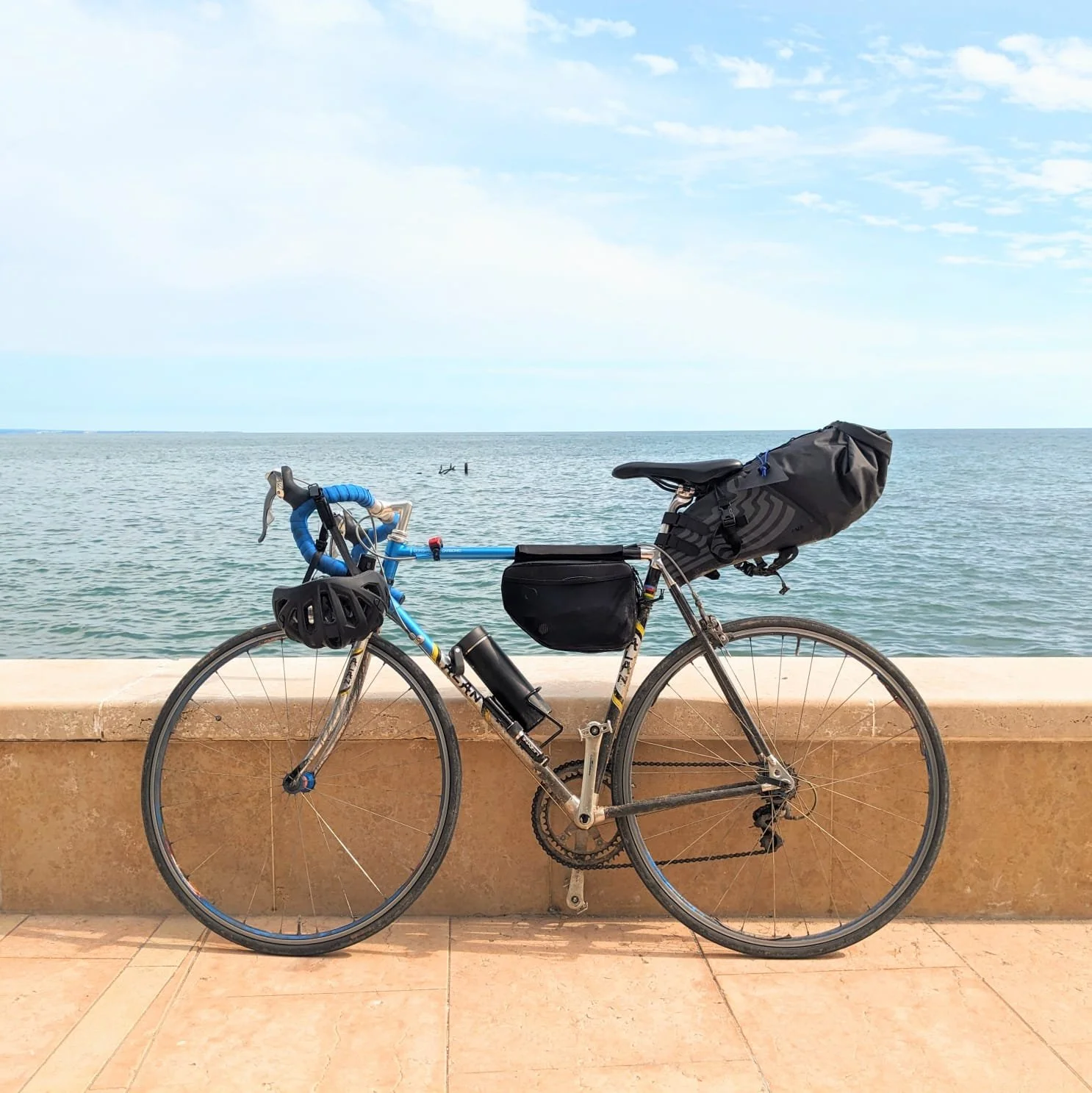
I stopped Severino at the first lookout. I dutifully took a picture of him between the throngs of tourists and retired to a bar. As I sipped the Aperol, I became even more somber. All that day, I had dwelled on why I loved Severino so much. On why it felt right to take Severino back to Italy solely on the idea it would be poetic.
Sitting there, I realized it was because Severino brings out the part of me that enjoys doing things purely because they are poetic. He reminds me to still be unreserved with the world. Sipping my way through the Aperol, I hoped that impulse would not end with the route.